Dustbin::Games Framework
A modular C++17 game and tool development framework built around the Irrlicht 3D Engine. It enforces strict separation of concerns through a Bidirectional Command Stack, Code-Generated Strongly Typed Messages, and a single unified JSON Project Definition.
1. How the Framework Works
Instead of coupling user input, gameplay rules, physics, networking, and 3D/2D rendering inside monolithic classes, the Dustbin::Games Framework decomposes an application into two orthogonal layers:
- Compile-Time Modules (
_source/modules/*): Self-contained static libraries (each configured via amodule.jsonmanifest) that declare their transitive dependencies, third-party VCPKG libraries (FreeType, SFML Audio, ODE, ENet), required runtime assets (data/), and startup registration hooks. - Runtime Commands (
command::ICommand): Independent functional units pushed onto a vertical Command Stack (command::ICommandStack) that communicate exclusively by sending Input Messages downward and Output Messages upward.
1. Central Coordinator (CMainClass)
dustbin::CMainClass owns the IDataHub and the main ICommandStack.
It registers itself as the Irrlicht IEventReceiver, captures engine log messages from startup into an inspectable log vector, and drives the main loop via while (l_cMain.run());.
2. Service Locator (IDataHub)
data::IDataHub creates and holds the IrrlichtDevice, IVideoDriver, ISceneManager, IGUIEnvironment, and IFileSystem, alongside pluggable framework subsystems: IFontManager, IAudioInterface, IL10n, ISceneRenderer, persistent getSettings(), and transient getGlobals().
3. Automatic Module Initialization
During project generation, the build scripts inspect every enabled module's module.json for an "initialize" entry and generate CInitModules.h/.cpp. Calling dustbin::modules::initFrameworkModules(&l_cMain) invokes each module's registration function in ascending priority order (e.g., priority 50 → 75 → 99 → 100).
4. Command Stack (ICommandStack)
All runtime work happens inside command::ICommand subclasses pushed to the stack via pushToStack(). Every frame, CCommandStack::run() executes active commands, removes commands whose hasFinished() returns true, and routes Irrlicht GUI/mouse/keyboard events to commands where handlesIrrlichtEvents() == true.
Application Startup Lifecycle
Every application generated by the framework follows a clean, predictable entry-point pattern (as seen in both VierGewinnt.cpp and TrackEd_Internal.cpp):
int main(void) {
  // 1. Configure application & project identifiers for portable settings/data paths
  dustbin::data::CDataHub::setApplicationName(_APPLICATION);
  dustbin::data::CDataHub::setProjectName    (_PROJECTNAME);

  // 2. Instantiate the central coordinator (creates CDataHub & main CCommandStack)
  dustbin::CMainClass l_cMain;

  // 3. Run auto-generated module initializers sorted by module.json priority
  //    (Registers FreeType fonts, L10n, SFML Audio, DustbinGUI factories, Shaders, Skybox, ODE, etc.)
  dustbin::modules::initFrameworkModules(&l_cMain);

  // 4. Push the initial command(s) onto the command stack (e.g. Main Menu or 3D Editor)
  l_cMain.getCommandStack()->pushToStack(
    new dustbin::command::CMenuMain(l_cMain.getDataHub(), l_cMain.getCommandStack())
  )->drop();

  // 5. Run the main loop until the command stack is cleared
  while (l_cMain.run());
  return 0;
}
Stack Stashing & Modal Execution (stash / stashPop)
A signature feature of command::ICommandStack is its ability to suspend and restore entire application states—including the active Irrlicht ISceneManager and IGUIEnvironment—without destroying them:
- In
VierGewinnt: When the user clicks "Start Game", "Start Network", "Join Network", or "Replay" inCMenuMain, the menu callsm_pStack->stash(nullptr, nullptr), hides its menu tabs, and pushes the gameplay commands onto the fresh stack. When the match finishes, the gameplay stack clears itself and callsm_pStack->stashPop(nullptr, nullptr), triggeringCMenuMain::onStashPop()to immediately restore the main menu. - In
FlatTrack Racing: Built on an "Editor-First" philosophy,CTheActualSceneEditorclones the edited 3D scene into a temporarym_pSmgrTest = m_pSmgr->createNewSceneManager(true), callsm_pStack->stash(m_pSmgr, m_pGui)to safely freeze the 3D scene editor and its undo/redo history, and pushes the live racing simulation commands (CCommandRace,CCommandCameraChase,CCommandCarUI,CCommandDefaultScene,CCommandUserInput,CCommandTestSceneUI). PressingESCclears the test stack and pops the stash, returning to the exact editor state viaonStashPopEnd().
2. Complete List of Available Modules (42 Modules)
All 42 framework modules reside in _source/modules/. Each module is compiled as a separate static library target (DustbinFW_<module_name>) or included as a header-only interface library ("interface": true in module.json). When you select a module for an application, the project generator automatically resolves and includes all transitive module dependencies, VCPKG link libraries, and required data/ assets.
Core & System Modules
| Module Name | Type / Init Priority | Dependencies | Summary & Key Classes |
|---|---|---|---|
core_mainclass |
Static Lib | core_commandstack, core_datahub, helpers_dustbinhelpers |
Application entry-point coordinator (dustbin::IMainClass, dustbin::CMainClass). Owns the IDataHub and main ICommandStack, captures startup Irrlicht logs into a vector, and drives the per-frame execution loop. |
core_datahub |
Static Lib | render_default, audio_interfaces, font_interfaces, localize_dustbinl10n, system_platform |
Central service locator and shared resource container (data::IDataHub, data::CDataHub). Manages the Irrlicht device/driver/scene/GUI/filesystem, active font/audio/l10n/renderer subsystems, persistent settings, session globals, application identity metadata (getApplicationName(), getProjectName(), getSettingsName(), getVersion()), active data archive name (setDataFileName() / getDataFileName()), and custom named reference-counted objects. |
core_commandstack |
Static Lib | core_messages, core_log, font_interfaces |
Implements the bidirectional command stack architecture (command::ICommand, command::CCommandStack, command::CCommandProxy, command::ICommandDialogEdit, command::IStackObserver) with downward Input and upward Output message routing and stack stashing. |
core_messages |
Header-Only Interface | serializer_interfaces |
Foundational messaging interfaces: messages::IMessage (16-bit type ID, validity flag, cloning, serialization), messages::IMessageFactory (deserializing messages by type ID), and messages::IMessageProxyFilter (filtering messages across stack proxies). |
core_threads |
Static Lib | core_messages |
Multithreading primitives (threads::IThread wrapping std::thread) with built-in thread-safe mutex-protected message queues (threads::CInputQueue and threads::COutputQueue) that automatically clone broadcast messages. |
core_log |
Static Lib | None | Lightweight global logging facility (dustbin::log(...) and dustbin::setLogCallback(...)) allowing any module or background worker thread to emit structured Irrlicht log messages without holding a direct pointer to IDataHub. |
system_platform |
Static Lib | helpers_dustbinhelpers, core_datahub |
Cross-platform OS abstractions (CPlatformWindows.cpp / CPlatformLinux.cpp) providing platform::portableGetDataPath(), portableGetFontPath(), getDrives(), portableItoa(), and portableDateStr(). |
system_datafile |
Static Lib Init: 75 |
None | Virtual file system archive loader. On application startup, queries data::IDataHub::getDataFileName() and automatically mounts the packaged data ZIP archive (configured via the _DATAFILE compile definition or Release Wizard) into Irrlicht's file system via addFileArchive(..., EFAT_ZIP) so all assets are loaded transparently. |
Rendering & 3D Scene Modules
| Module Name | Type / Init Priority | Dependencies | Summary & Key Classes |
|---|---|---|---|
render_default |
Static Lib | None | Defines the engine-independent render::ISceneRenderer interface (shadow map pass, scene pass, node registration) and provides the standard fallback renderer render::CSceneRenderer_default wrapping ISceneManager::drawAll(). |
render_dustbinshader |
Static Lib Init: 99 |
core_mainclass, core_datahubData: data/shaders |
Custom GLSL shadow-mapping scene renderer based on the Dustbin::Games Shader pipeline. Registers itself with IDataHub::setSceneRenderer(...) via registermodule_render_dustbinshader. |
render_aishader |
Static Lib Init: 99 |
core_mainclass, core_datahubData: data/shaders_ai |
Advanced GLSL shader pipeline supporting solid and transparent Cascaded Shadow Mapping (CSM), transparent depth atlas passes, and 2-layer multi-texture blending (used in FlatTrack Racing). Registered via registermodule_render_aishader. |
scene_skybox |
Static Lib Init: 100 |
None | Procedural atmospheric skybox scene node (scene::CDustbinSkyBox & CDustbinSkyboxFactory). Generates 6 cubemap faces asynchronously on a background thread using the Preetham scattering model with a 24-hour day/night cycle, latitude-based sun/moon paths, stars, and procedural clouds. |
scene_cameracontrol |
Static Lib | None | Interactive 3D camera controller (scene::CCameraControl) implementing irr::IEventReceiver for orbiting, panning, and zooming an ICameraSceneNode in 3D editors and tools. |
scene_nodedata |
Static Lib | None | Internal scene node ID tracker (scene::INodeDataManager, scene::CNodeDataManager). Assigns unique internal IDs to ISceneNode* instances so editors, physics, and serializers can reference nodes reliably even when Irrlicht node IDs collide. |
scene_animators |
Static Lib Init: 99 |
None | Custom Irrlicht scene node animators and factory registered on startup via registermodule_scene_dustbinanimators. |
scene_audionodes |
Static Lib Init: 99 |
audio_3dsound, physics_interfaces |
Custom scene nodes that attach positional 3D sound sources and physics sound triggers to parent scene nodes. Registered via registermodule_scene_audionodes. |
scene_unknown |
Static Lib Init: 99 |
core_log, helpers_dustbinhelpers |
Provides fallback factories for unknown scene nodes and unknown animators (registermodule_scene_unknownnodes) so generic scene editors can load, inspect, and re-save scenes containing game-specific node types without losing their serialized attributes. |
Physics & Audio Modules
| Module Name | Type / Init Priority | Dependencies | Summary & Key Classes |
|---|---|---|---|
physics_interfaces |
Static Lib | core_commandstack, core_messages |
Engine-independent 3D physics interfaces (physics::IPhysicsManager, IPhysicsObject, IPhysicsNodeBody) and pre-generated physics messages (CPhysicsMessages.h / scripts/physics.json: PhysicsObjectMoved, PhysicsObjectTrigger, PhysicsObjectSetState, PhysicsStep, PhysicsObjectEnabled/Disabled) plus IPhysicsEngineCommand and IDefaultSceneCommand. |
physics_ode |
Static Lib Init: 99 |
physics_interfacesVCPKG: ODE::ODE |
Concrete 3D rigid-body physics implementation using the Open Dynamics Engine (ODE) with double precision and trimesh collision support (CCommandPhysics_ODE). Registered via registermodule_physics_ode. |
audio_interfaces |
Header-Only Interface | None | Core audio abstractions (audio::IAudioInterface, no-op fallback CAudioInterface_None, ISound3d, IPhysicsSound, INodeAudioDataProvider) decoupling game/scene code from the audio backend. |
audio_3dsound |
Static Lib | audio_interfaces, helpers_dustbinhelpers, core_log |
Physics-driven 3D positional sound effects: CPhysicsSound_Movement (continuous velocity-scaled rolling/sliding sound), CPhysicsSound_Impact (collision impulse sound), and CPhysicsSound_Activation / Deactivation. |
audio_sfml |
Static Lib Init: 99 |
audio_3dsound, scene_audionodesVCPKG: SFML::Audio |
Default audio engine implementation powered by SFML Audio (CAudioInterface_SFML, CSound2d, CSound3d). Registered with IDataHub on startup via registermodule_audio_sfml. |
GUI, Fonts, Input & Localization Modules
| Module Name | Type / Init Priority | Dependencies | Summary & Key Classes |
|---|---|---|---|
gui_dustbingui |
Static Lib Init: 99 |
localize_dustbinl10n, font_interfaces, controller_dustbincontroller, helpers_dustbinhelpers, core_datahub, core_mainclass, font_freetype |
Comprehensive suite of custom Irrlicht GUI elements and factories (registermodule_gui_dustbingui), including log displays (CGuiLogDisplay), ribbon menus, custom tabs, buttons, and XML-driven dialog layouts. |
font_interfaces |
Header-Only Interface | None | Defines font::IFontManager for querying TrueType fonts by name/style/size, registering custom fonts, enumerating system fonts, and managing the font cache. |
font_freetype |
Static Lib Init: 75 |
font_interfaces, helpers_dustbinhelpersVCPKG: Freetype::Freetype |
FreeType-powered implementation of font::IFontManager (font::CFontManager and font::CGUITTFont) providing anti-aliased TrueType (.ttf / .otf) glyph rasterization and kerning. Registered at priority 75 via registermodule_font_freetype. |
localize_interfaces |
Header-Only Interface | None | Defines the l10n::IL10n localization interface for translating UI strings and identifiers across languages. |
localize_dustbinl10n |
Static Lib Init: 75 |
helpers_dustbinhelpers, localize_interfaces, core_mainclass, core_datahub |
Dictionary-based localization system (registermodule_dustbinl10n). Stores localized strings in text files; in Debug builds, missing translation keys are automatically collected and written out on program exit. |
controller_dustbincontroller |
Static Lib | None | Configurable input controller abstraction (controller::IDustbinController) mapping keyboard keys and joystick axes, buttons, and POV hats to logical game controls: Fader ([0..1] or combined bidirectional axis [-1..1]), Button, and single-tick Trigger. Supports saving/loading mappings via irr::io::IAttributes. |
event_eventhandlers |
Static Lib | None | Structured base classes (event::IGuiEventHandler and event::IMouseEventHandler) that decompose Irrlicht's irr::SEvent union into clean virtual methods (onButtonClicked, onCheckboxChanged, onTreeviewNodeSelected, mouse button/wheel callbacks, etc.). |
Networking & Serialization Modules
| Module Name | Type / Init Priority | Dependencies | Summary & Key Classes |
|---|---|---|---|
network_enet |
Static Lib | core_commandstack, core_threads, core_messages, serializer_interfaces, core_logVCPKG: unofficial-enet |
Bridges the command stack across the network over reliable UDP using ENet in background threads. CCommandENetServer serializes incoming Output messages and broadcasts them to clients, while deserializing client packets into Input messages. CCommandENetClient serializes incoming Input messages to the server and emits server packets as Output messages. |
network_discovery |
Static Lib | core_commandstack, core_threads, serializer_interfaces, core_logVCPKG: unofficial-enet |
Automatic LAN server discovery over UDP broadcast datagrams (CCommandDiscoveryServer and abstract CCommandDiscoveryClient with pure virtual serverFound(name, ip, port) callback). Operates on background threads every 500 ms without requiring user IP entry. |
serializer_interfaces |
Header-Only Interface | None | Defines type tags (enSerializeDataTypes: String, WString, UInt8..64, Int8..64, Float32/64, Boolean, Vector3df/2df/2di, Quaternion) and the ISerializer, IDeSerializer, and ISerializerFactory interfaces. |
serializer_bin |
Static Lib | serializer_interfaces |
Architecture-independent binary serializer (CSerializerBin, CDeSerializerBin, CSerializerFactoryBin). Encodes multi-byte numbers/vectors in canonical big-endian network byte order and std::wstring as portable UTF-8 with strict bounds checking. Used for network packets. |
serializer_xml |
Static Lib | serializer_interfaces, helpers_dustbinhelpers |
Human-readable XML implementation (CSerializerXML, CDeSerializerXML) of ISerializer and IDeSerializer. Used for saving game replays (e.g., replay.xml in VierGewinnt) and structured data files. |
data_serializerbin |
Static Lib | serializer_interfaces |
Compact binary data serializer/deserializer encoding typed tokens with a "msg\0" header for local binary persistence. |
Editors & Helper Modules
| Module Name | Type / Init Priority | Dependencies | Summary & Key Classes |
|---|---|---|---|
commands_guieditor |
Static Lib Init: 50 |
core_commandstack, core_log, core_mainclass, editor_commands, editor_general, editor_undoredo, event_eventhandlers, font_freetype, gui_dustbingui, helpers_dustbinhelpers, localize_dustbinl10n, system_platform |
Complete 2D GUI Editor command suite (MainDialog, AttributeCommand, TreeCommand, CommandUIElement, HotkeyCommand) and dialog assets (data/dialogs/Editor_2d.xml) for visually building Irrlicht/DustbinGUI XML layouts. |
commands_sceneeditor |
Static Lib Init: 50 |
audio_interfaces, controller_dustbincontroller, core_commandstack, core_log, core_mainclass, editor_commands, editor_general, editor_undoredo, event_eventhandlers, gui_dustbingui, helpers_dustbinhelpers, localize_dustbinl10n, physics_interfaces, scene_cameracontrol, scene_nodedata, scene_animators, system_platform |
Extensible 3D Scene Editor command suite (CEditor3dMain, MouseCommand, CameraCommand, MoveNodeCommand, TreeCommand, AttributeCommand, TestSceneCommand) with built-in 3D gizmos, scene tree hierarchy, attribute editing, and in-editor physics/audio scene playtesting. |
editor_commands |
Static Lib Init: 99 |
font_interfaces, helpers_dustbinhelpers, core_commandstack, gui_dustbingui, localize_dustbinl10n, editor_undoredo |
Specialized modal attribute editor commands (ICommandEditAttributeFactory for file pickers, textures, meshes, sounds, colors, vectors) and the custom Irrlicht material inspector (CGuiMaterialEditor, registered via registermodule_gui_materialeditor). |
editor_general |
Static Lib Init: 99 |
core_datahub, editor_undoredo, editor_commands |
General attribute inspection UI (gui::CGuiAttributeEditor for any irr::io::IAttributeExchangingObject) and attribute undo/redo state items (undoredo::CUndoRedoAttributes). Registered via registermodule_editor_general. |
editor_undoredo |
Static Lib | editor_general |
Linear undo/redo history stack manager (undoredo::IUndoRedoManager, CUndoRedoManager, IUndoRedoItem) with modification flag tracking for editors. |
helpers_dustbinhelpers |
Static Lib | system_platform |
General-purpose utilities: CStringHelpers (UTF-8/wstring conversions, splitting, trimming), CDataHelpers, CDrawHelpers, CSceneHelpers / CSceneLoader, CInputLimiter, CUuidGenerator, math::CBezier, and gui::IProgressCallback. |
helpers_random |
Static Lib | None | Deterministic, cross-platform 64-bit PRNG (helpers::CRandom) implementing xoshiro256** with SplitMix64 seeding and rejection-sampled ranged queries, guaranteeing bit-identical sequences across Windows/Linux and x86/x64/ARM. |
3. The Messaging System in Detail
In a Dustbin::Games Framework application, commands on the ICommandStack never call gameplay methods directly on one another. Instead, every command::ICommand is linked into a vertical doubly-linked chain via two pointers:
m_pInputCommand: Points to the command immediately above this command on the stack.m_pOutputCommand: Points to the command immediately below this command on the stack.
- Input Messages (
sendInputMessage→ flows DOWN): Originate from commands higher up on the stack (such as user input handlers, AI controllers, network servers receiving client requests, or one-shot startup triggers) and travel downward throughm_pOutputCommand->receiveInputMessage(pMsg)toward the authoritative game logic or physics engine at the bottom of the stack. - Output Messages (
sendOutputMessage→ flows UP): Originate from lower-level commands (such as the game rules engine, physics simulation, or network client receiving server broadcasts) and travel upward throughm_pInputCommand->receiveOutputMessage(pMsg)toward 3D scene renderers, audio nodes, HUD overlays, camera controllers, and replay recorders.
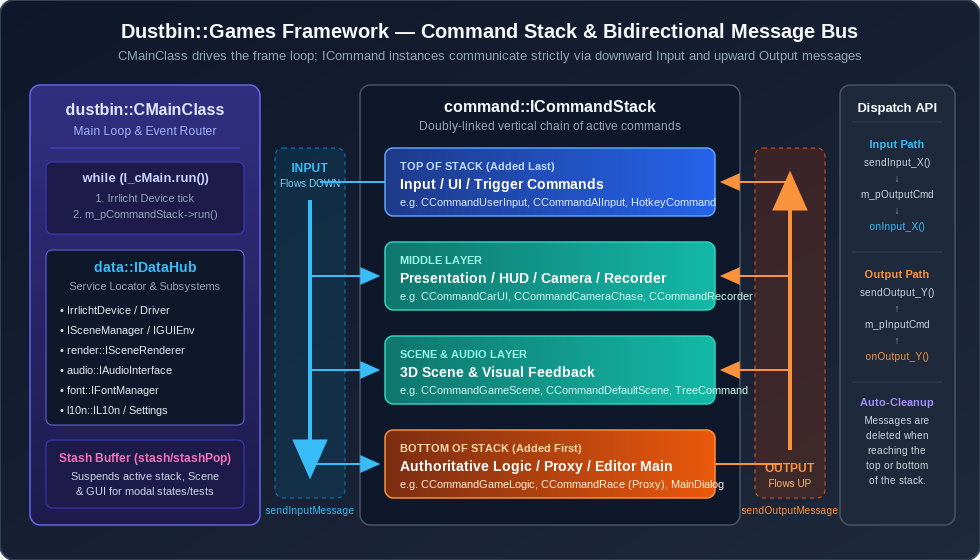
CMainClass, IDataHub, and the vertical ICommandStack showing downward Input and upward Output message flow.
How a Message Travels Through ICommand
When a command calls sendInputMessage(l_pMsg) (or one of the generated type-safe helper methods like sendInput_CoinDrop(playerId, column)), the following exact sequence occurs inside ICommand:
sendInputMessage(a_pMessage)checks if there is a command below it (m_pOutputCommand != nullptr).- If a lower command exists, it invokes
m_pOutputCommand->receiveInputMessage(a_pMessage). - Inside
receiveInputMessage(a_pMessage), the receiving command first calls its virtualhandleMessageInput(a_pMessage)hook, and then automatically forwards the message further down the stack by callingsendInputMessage(a_pMessage). - When the message finally reaches the bottom-most command on the stack (where
m_pOutputCommand == nullptr),inputMessageWillBeDeleted(a_pMessage)is called and the message object is automatically deleted (delete a_pMessage).
The exact mirror process happens for Output Messages traveling upward via sendOutputMessage → m_pInputCommand->receiveOutputMessage → handleMessageOutput → auto-deletion at the top of the stack (m_pInputCommand == nullptr).
Automated C++ Code Generation from JSON
Writing manual message classes, serialization logic, type-switch dispatchers, and stack filters by hand is error-prone. The framework's message generator (generate_messages_cpp in scripts/python_modules/ProjectGenerator.py, invoked via ProjectManagement.py or CreateProjectFiles.py) takes the "message_definition" section of the project JSON and generates four categories of C++ files:
1. Message Enum & Classes (C<Base>.h/.cpp)
Generates the enum class en<Enum> and strongly-typed messages::C<MessageName> subclasses deriving from messages::IMessage. Each class includes typed member fields, getters, a value constructor, a deserializing constructor C<Msg>(IDeSerializer*) with strict type-tag validation, clone(), and serialize(ISerializer*).
2. Message Factory (C<Factory>.h/.cpp)
Generates a concrete messages::IMessageFactory implementation whose createMessage(IDeSerializer*) reads the 16-bit message type ID from a binary or XML stream and instantiates the matching C<MessageName> class. Used by network_enet and replay loaders.
3. Command Interfaces (I<Interface>.h/.cpp)
For every entry in "interfaces", generates a base command class deriving from command::ICommand (or a custom base class).
Messages listed in send.input / send.output become ready-to-call methods (sendInput_X(...), sendOutput_Y(...)).
Messages listed in receive.input / receive.output become pure virtual callbacks (virtual void onInput_X(...) = 0;, virtual void onOutput_Y(...) = 0;) automatically unpacked inside the generated handleMessageInput / handleMessageOutput switch statements!
4. Stack Proxy Filters (C<Proxy>.h/.cpp)
When an application uses multiple command stacks (e.g. "main" and "physics"), the generator analyzes which messages are sent on one stack and received on the other, and automatically emits an IMessageProxyFilter class (forwardInputMessage / forwardOutputMessage) that only forwards relevant messages across the stack boundary.
Case Study 1: Message Flow in VierGewinnt (SourceForge Repository)
VierGewinnt (Connect Four) is a single-stack turn-based 3D game that showcases how complete separation between game rules, 3D rendering, human mouse raycasting, Minimax AI, XML replay recording, and LAN multiplayer is achieved purely through the command stack.
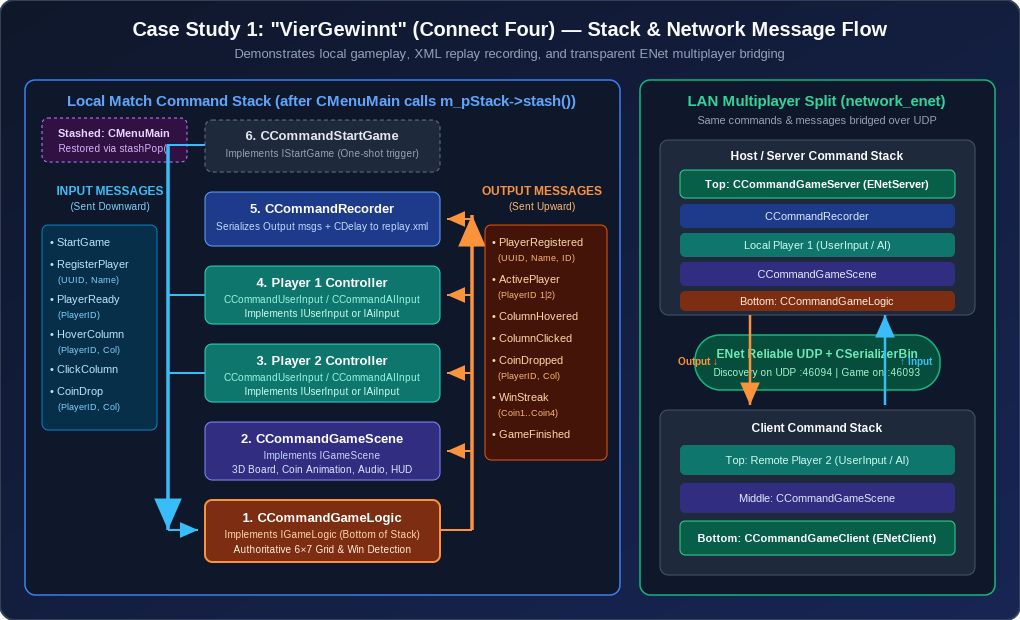
network_enet (right).
Defined Messages in VierGewinnt.json (14 Messages)
| Message Name | Direction | Fields (Name : Type) | Purpose in the Game Flow |
|---|---|---|---|
StartGame |
Input ↓ | No fields | Sent once by the transient CCommandStartGame at the top of the stack to trigger player registration. |
RegisterPlayer |
Input ↓ | PlayerUUID: String, Name: String |
Sent downward by each player controller (CCommandUserInput or CCommandAIInput) upon receiving StartGame. |
PlayerRegistered |
Output ↑ | PlayerUUID: String, Name: String, PlayerID: UInt8 |
Sent upward by CCommandGameLogic assigning internal PlayerID (1 or 2) to the matching UUID. |
PlayerReady |
Input ↓ | PlayerID: UInt8 |
Sent downward by a player controller to confirm it has received its PlayerID and is ready to start. |
ActivePlayer |
Output ↑ | PlayerID: Int8 |
Broadcast upward by CCommandGameLogic to announce whose turn it is (1 or 2). |
HoverColumn |
Input ↓ | PlayerID: UInt8, Column: UInt8 |
Sent downward by the active player/AI when hovering a board column (0..6, or 255 if none). |
ColumnHovered |
Output ↑ | PlayerID: UInt8, Column: UInt8 |
Validated and echoed upward by CCommandGameLogic so CCommandGameScene highlights the 3D column arrow. |
ClickColumn |
Input ↓ | PlayerID: UInt8, Column: UInt8 |
Sent downward by the active controller when clicking a column. |
ColumnClicked |
Output ↑ | PlayerID: UInt8, Column: UInt8 |
Echoed upward by CCommandGameLogic for visual/audio click feedback in CCommandGameScene. |
CoinDrop |
Input ↓ | PlayerID: UInt8, Column: Int8 |
Sent downward by the active player controller requesting to drop a chip into Column. |
CoinDropped |
Output ↑ | PlayerID: Int8, Column: UInt8 |
Sent upward by CCommandGameLogic after updating the 6×7 board array; triggers the 3D falling coin animation in CCommandGameScene and updates the board state inside CCommandAIInput. |
WinStreak |
Output ↑ | Coin1: Vector2di, Coin2: Vector2di, Coin3: Vector2di, Coin4: Vector2di |
Sent upward by CCommandGameLogic when 4-in-a-row is detected, providing the grid coordinates of the 4 winning coins so CCommandGameScene can highlight them. |
GameFinished |
Output ↑ | Winner: Int8 |
Sent upward by CCommandGameLogic when the match ends (0 = draw, 1 = Player 1 wins, 2 = Player 2 wins). |
Delay |
Replay | timestamp: UInt32 |
Inserted by CCommandRecorder into replay.xml (using serializer_xml) before each recorded Output message so CCommandReplay can reproduce exact match timing. |
Generated Command Interfaces in VierGewinnt
IGameLogic(implemented byCCommandGameLogicat the bottom of the stack): Receives all 6 Input messages (StartGame,RegisterPlayer,PlayerReady,HoverColumn,ClickColumn,CoinDrop) and sends all 7 Output messages.IGameScene(implemented byCCommandGameScenejust aboveCCommandGameLogic): Sends no messages; receives all 7 Output messages to render the 3D board, animate falling coins, play 3D sounds, and display the winner overlay.IUserInput&IAiInput(implemented byCCommandUserInputandCCommandAIInput): Receive InputStartGameand OutputPlayerRegistered,ActivePlayer(plusCoinDroppedfor AI); send InputRegisterPlayer,PlayerReady,HoverColumn,ClickColumn, andCoinDrop. Because both human and AI controllers use the exact same message protocol, any combination (Human vs. Human, Human vs. AI, AI vs. AI) works simply by pushing the chosen controller classes onto the stack!IStartGame(implemented byCCommandStartGameat the top of the stack): Sends InputStartGameon its first frame and returnshasFinished() == trueso the stack automatically removes it.
- Replay System:
CCommandRecordersits near the top of the stack and intercepts every Output message coming fromCCommandGameLogic, serializing aCDelaytimestamp message and the Output message itself intoreplay.xmlviaCSerializerXML. When the user clicks "Replay" in the main menu,CMenuMainsimply pushesCCommandReplayat the bottom of the stack (in place ofCCommandGameLogic) andCCommandGameSceneabove it!CCommandReplayreadsreplay.xmland emits the recorded Output messages upward at their original timestamps—CCommandGameScenerenders the entire match without knowing it is watching a replay. - LAN Multiplayer (
network_enet+network_discovery): On the Host machine,CCommandGameServer(deriving fromCCommandENetServer) is pushed aboveCCommandRecorder. It automatically serializes all Output messages traveling up fromCCommandGameLogicusingCSerializerFactoryBinand broadcasts them over UDP to the client, while deserializing incoming client packets and injecting them downward as Input messages. On the Client machine,CCommandGameClient(deriving fromCCommandENetClient) sits at the bottom of the stack (replacingCCommandGameLogic!), withCCommandGameSceneand the remote player'sCCommandUserInputabove it.
Case Study 2: Multi-Stack Proxy Message Flow in FlatTrack Racing (SourceForge Repository)
FlatTrack Racing demonstrates a more advanced architectural pattern: Multiple Command Stacks connected by a Command Proxy (command::ICommandProxy) and Shared Message Includes (physics.json).
In FlatTrack Racing, the "message_definition" in DustbinFlatTrack.json (and Messages/FlatTrackRacing.json) includes the framework's built-in physics.json (with "generate": false, since those classes are already compiled inside physics_interfaces) and assigns interfaces to two distinct command stacks: "main" and "physics".
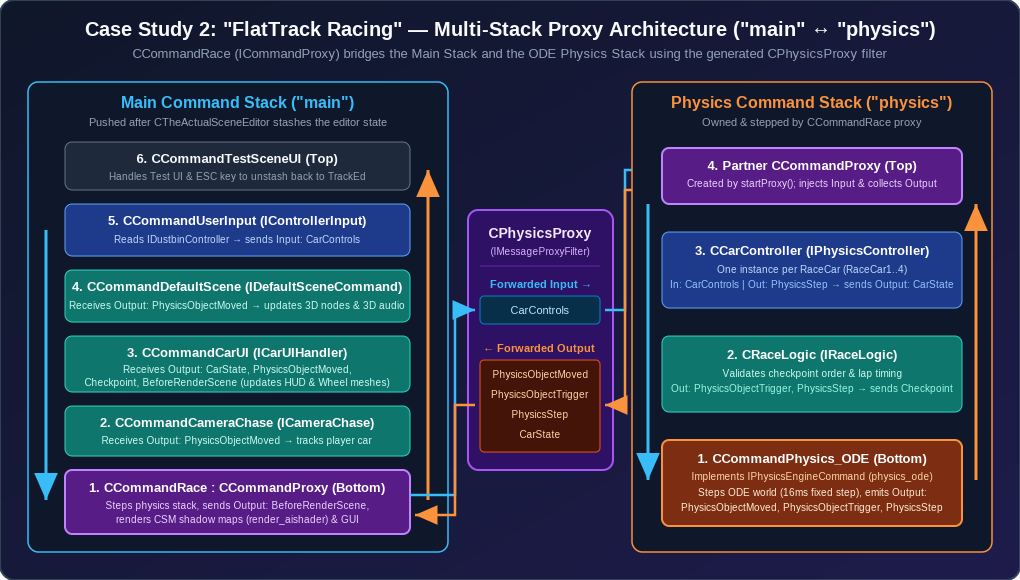
"main" stack and the "physics" stack via CCommandRace and the generated CPhysicsProxy filter.
How the Two Command Stacks Connect via CCommandProxy
When playtesting a track in CTheActualSceneEditor::createTestSceneCommands(), the editor stashes the editing scene and constructs the main stack from bottom to top:
- Bottom of
"main"stack —CCommandRace(derives fromCCommandTestScene→CCommandProxy): In its constructor,CCommandRacecreates a second internal command stack (the"physics"stack) and pushes:CCommandPhysics_ODE(at the bottom of the"physics"stack, implementingIPhysicsEngineCommandfromphysics.json, stepping the ODE world at a fixed 16 ms step).CRaceLogic(implementingIRaceLogic, tracking lap counts and checkpoint trigger order).- 1 to 4
CCarControllerinstances (implementingIPhysicsController, one for eachRaceCar1..4node found in the scene).
CCommandRacecallsstartProxy(), which places a partnerCCommandProxyat the top of the"physics"stack linked toCCommandRace. - Above
CCommandRaceon the"main"stack:CCommandCameraChase(ICameraChase) →CCommandCarUI(ICarUIHandler) →CCommandDefaultScene(IDefaultSceneCommand) →CCommandUserInput(IControllerInput) →CCommandTestSceneUI(at the top).
Messages & Cross-Stack Routing in FlatTrack Racing
| Message Name | Defined In | Origin Stack & Sender | Crosses Proxy? | Receiving Commands & Actions |
|---|---|---|---|---|
CarControls |
FlatTrackRacing.json |
Main Stack (Input ↓)CCommandUserInput (IControllerInput) |
Yes (Main → Physics) Allowed by CPhysicsProxy::forwardInputMessage |
Received as Input on the "physics" stack by CCarController (IPhysicsController), which applies throttle, steering, handbrake, and gear shifts to the car's ODE physics body. |
PhysicsStep(ID: 1003) |
physics.json |
Physics Stack (Output ↑)CCommandPhysics_ODE |
Yes (Physics → Main) Allowed by CPhysicsProxy::forwardOutputMessage |
Received on the "physics" stack by CRaceLogic (updates lap timer in simulation steps) and CCarController (triggers sendOutput_CarState(...) after each physics step). |
PhysicsObjectMoved(ID: 1000) |
physics.json |
Physics Stack (Output ↑)CCommandPhysics_ODE |
Yes (Physics → Main) Allowed by CPhysicsProxy::forwardOutputMessage |
Forwarded to the "main" stack and received as Output by:
• CCommandCameraChase (updates chase camera target/transform)
• CCommandCarUI (tracks car position)
• CCommandDefaultScene (updates Irrlicht 3D scene node positions, rotations, and 3D velocity audio). |
PhysicsObjectTrigger(ID: 1001) |
physics.json |
Physics Stack (Output ↑)CCommandPhysics_ODE |
Yes (Physics → Main) Allowed by CPhysicsProxy::forwardOutputMessage |
Received on the "physics" stack by CRaceLogic (IRaceLogic) when a car hits a checkpoint trigger volume. If the checkpoint is valid in sequence, CRaceLogic emits a Checkpoint Output message. |
CarState |
FlatTrackRacing.json |
Physics Stack (Output ↑)CCarController (IPhysicsController) |
Yes (Physics → Main) Allowed by CPhysicsProxy::forwardOutputMessage |
Carries 19 fields (Speed, RPM, Gear, Steering, Throttle, HandBrake, Clutch, ShiftUp/Down indicators, front wheel steering angle, 4 wheel roll pitch angles, and 4 wheel suspension displacements). Received on the "main" stack by CCommandCarUI to update the cockpit HUD and visual wheel/suspension sub-meshes. |
Checkpoint |
FlatTrackRacing.json |
Physics Stack (Output ↑)CRaceLogic (IRaceLogic) |
Forwarded via Proxy to Main Stack | Carries CarId, Checkpoint, LapNo, LapCount, and Timestamp. Received by CCommandCarUI (ICarUIHandler) to display sector/lap times on the racing HUD. |
BeforeRenderScene |
FlatTrackRacing.json |
Main Stack (Output ↑)CCommandRace::run() |
No (Local to Main Stack) | Emitted right after m_pDrv->beginScene() before shadow-map and scene rendering. Received by CCommandCarUI to apply visual wheel steering/pitch/suspension transforms right before draw calls. |
How the Code Generator Automatically Built CPhysicsProxy.cpp
Because DustbinFlatTrack.json declares a proxy entry with "commandstack": "main" and "createsstack": "physics":
"proxies": [
  {
    "name": "PhysicsProxy",
    "comment": "This is the proxy which creates the physics command stack and it forwards commands forth and back",
    "commandstack": "main",
    "createsstack": "physics"
  }
]
The message generator cross-referenced all messages sent by interfaces on "main" against those received by interfaces on "physics" (and vice versa), automatically generating CPhysicsProxy::forwardInputMessage and CPhysicsProxy::forwardOutputMessage:
bool CPhysicsProxy::forwardInputMessage(messages::IMessage *a_pMsg) {
  irr::u16 l_iType = a_pMsg->getType();
  return l_iType == (irr::u16)enFlatTrackMsg::CarControls;
}

bool CPhysicsProxy::forwardOutputMessage(messages::IMessage *a_pMsg) {
  irr::u16 l_iType = a_pMsg->getType();
  return l_iType == (irr::u16)enPhysicsMsg::PhysicsObjectMoved
      || l_iType == (irr::u16)enFlatTrackMsg::CarState
      || l_iType == (irr::u16)enPhysicsMsg::PhysicsObjectTrigger
      || l_iType == (irr::u16)enPhysicsMsg::PhysicsStep;
}
4. The JSON Project Definition File
Every Dustbin::Games Framework project (such as VierGewinnt/project/VierGewinnt.json, FlatTrack/project/DustbinFlatTrack.json, or the framework's own scripts/dustbineditors.json) is driven by a single combined JSON project definition file.
This file is managed visually via scripts/ProjectManagement.py (which unifies the Project Settings, Project Wizard, Message Wizard, and Release Wizard in one GUI) or built headless from the command line via scripts/CreateProjectFiles.py <project.json>.
Top-Level JSON Structure
A combined project definition JSON file consists of four top-level keys:
{
  "settings": { ... },            // 1. Project metadata & relative directory paths
  "projectdefinition": { ... },   // 2. Executable targets (apps), source/header folders & selected modules
  "message_definition": [ ... ],  // 3. One or more message/interface/proxy code-generation sets
  "release_definitions": [ ... ]  // 4. Standalone release packaging & asset compression configs
}
4.1. "settings" & "projectdefinition" Sections
settings.projectfolderis resolved relative to the folder containing the project.jsonfile (e.g., whenVierGewinnt.jsonis located inVierGewinnt/project/VierGewinnt.json, setting"projectfolder": ".."resolves the project root toVierGewinnt/).- All other paths in the JSON file—
cmakefolder,buildfolder, appsource/headerfolders, messageoutputfolder_source/outputfolder_header, and release file paths—are resolved relative tosettings.projectfolder!
"settings": {
  "projectname": "FlatTrackRacing",
  "company": "Dustbin::Games",
  "projectfolder": "..",
  "cmakefolder": "project",
  "buildfolder": "project/build",
  "version_major": 0,
  "version_minor": 1
},
"projectdefinition": {
  "apps": {
    "TrackEd_Internal": {
      "SettingsName": "TrackEd_Internal",
      "source": [
        "project/_source/TrackEd_Internal",
        "project/_source/GuiClasses",
        "project/_source/General_Game",
        "project/_source/General_TrackEd"
      ],
      "header": [
        "project/_source/TrackEd_Internal",
        "project/_source/GuiClasses",
        "project/_source/General_Game",
        "project/_source/General_TrackEd"
      ],
      "modules": [
        "commands_sceneeditor",
        "physics_ode",
        "render_aishader",
        "audio_3dsound",
        "scene_skybox",
        "gui_dustbingui"
        // Transitive dependencies (core_mainclass, core_datahub, core_commandstack, etc.)
        // are automatically resolved and added during generation!
      ]
    }
  }
}
For each application in projectdefinition.apps, the generator:
- Injects standard application compile definitions:
_APPLICATION="<AppName>",_PROJECTNAME="<ProjectName>",_VERSION="<major>.<minor>"(fromversion_major/version_minor), and_SETTINGSNAME="<SettingsName>". - Traverses the
module.jsonfiles of all listed modules to compute the full transitive dependency closure. - Generates
<first_source_folder>/CInitModules.handCInitModules.cpp(always overwritten) containingdustbin::modules::initFrameworkModules(IMainClass*)sorted by each module'sinitialize.priority. - Creates an initial entry-point file
<first_source_folder>/<AppName>.cpponly if it does not already exist (safe to customize), initializing application identity and data archive metadata inIDataHub. - Copies any module-required assets (declared in
module.json's"data"array, such as shaders, editor XML dialogs, and button icons) into the project'sdata/directory.
4.2. "message_definition" Section
The "message_definition" key is a JSON array, allowing a single project to generate multiple independent message sets (for example, dustbineditors.json defines separate message sets for the 2D GUI Editor and the 3D Scene Editor). Each entry in the array supports the following schema:
{
  "general": {
    "outputfolder_source": "project/_source/General_Game/_generated",
    "outputfolder_header": "project/_source/General_Game/_generated",
    "includepath": "_generated",
    "basefilename": "FlatTrackMessages",
    "enumeration": "FlatTrackMsg",
    "factoryname": "FlatTrackMsgFactory",
    "baseclasses": {
      "ICommandDialogEdit": "command/ICommandDialogEdit.h"
    }
  },
  "include": [
    {
      "file": "physics.json",
      "generate": false
    }
  ],
  "messages": [
    {
      "name": "CarControls",
      "id": 2000, // Optional explicit 16-bit enum ID
      "comment": "With this message the car is controlled",
      "fields": [
        { "name": "objectId",  "type": "UInt32",  "comment": "The Id of the car" },
        { "name": "throttle",  "type": "Float32", "comment": "The throttle position (-1.0 .. 1.0)" },
        { "name": "handbrake", "type": "Boolean", "comment": "Is the handbrake active?" }
      ]
    }
  ],
  "interfaces": [
    {
      "name": "TestSceneInput",
      "comment": "Reacts to the ESCAPE key to stop testing",
      "commandstack": "main",
      "irreventhandler": true,
      "inherits": {
        "baseclass": "command::CCommandTestScene",
        "include": "CCommandTestScene.h",
        "constructor": [
          { "type": "data::IDataHub *", "name": "a_pHub" },
          { "type": "irr::scene::ISceneManager *", "name": "a_pSmgr" },
          { "type": "command::ICommandStack *", "name": "a_pStack" }
        ]
      },
      "send":    { "input": [], "output": [] },
      "receive": { "input": [], "output": [] }
    }
  ],
  "proxies": [
    {
      "name": "PhysicsProxy",
      "comment": "Forwards messages between main and physics command stacks",
      "commandstack": "main",
      "createsstack": "physics"
    }
  ]
}
Supported Message Field Data Types (17 Types)
| JSON Field Type | Generated C++ Type | Default Initializer | ISerializer / IDeSerializer Methods |
|---|---|---|---|
String |
const std::string & |
"" |
addString / getString |
WString |
const std::wstring & |
L"" |
addWString / getWString (UTF-8 on wire in serializer_bin) |
UInt8, UInt16, UInt32, UInt64 |
irr::u8, irr::u16, irr::u32, irr::u64 |
0 |
addU8..addU64 / getU8..getU64 |
Int8, Int16, Int32, Int64 |
irr::s8, irr::s16, irr::s32, irr::s64 |
0 |
addS8..addS64 / getS8..getS64 |
Float32, Float64 |
irr::f32, irr::f64 |
0.0f, 0.0 |
addF32, addF64 / getF32, getF64 |
Boolean |
bool |
false |
addBool / getBool |
Vector3df |
const irr::core::vector3df & |
irr::core::vector3df() |
addVector3df / getVector3df |
Vector2df, Vector2di |
const irr::core::vector2df &, const irr::core::vector2di & |
irr::core::vector2df(), vector2di() |
addVector2df/2di / getVector2df/2di |
Quaternion |
const irr::core::quaternion & |
irr::core::quaternion() |
addQuaternion / getQuaternion |
4.3. "release_definitions" & Build Pipeline Tooling
The "release_definitions" array (used by the Release Wizard in ProjectManagement.py and seen in VierGewinnt.json) configures how compiled Release executables, data/ assets, and third-party license files are packaged for distribution:
"release_definitions": [
  {
    "destination_folder": "release",
    "compress_data": false,
    "zip_filename": null,
    "files": [
      {
        "path": "project/build/Release/VierGewinnt.exe",
        "target": "VierGewinnt.exe",
        "type": "application",
        "size": 7135744,
        "selected": true
      },
      {
        "path": "data/dialogs/4_gewinnt.xml",
        "target": "data/dialogs/4_gewinnt.xml",
        "type": "data",
        "size": 105224,
        "selected": true
      }
    ]
  }
]- When
"compress_data": trueis set (along with a"zip_filename"such as"data.zip"), all selected"type": "data"files are compressed into a single ZIP archive placed alongside the executable. The generator automatically adds_DATAFILE="<zip_filename>"to all application targets, whichsystem_datafileautomatically mounts into Irrlicht's virtual file system viaaddFileArchive(..., EFAT_ZIP)at startup. - The release packager automatically copies all required framework and third-party open-source license files (Irrlicht, FreeType, ZLib, libpng, jpeglib, brotli, bzip2, etc.) from
license/into<destination_folder>/licenses/. - The Release Wizard toolbar includes Add App (manual file picker to add standalone executables to the release tree) and Del App (remove selected application).
- Clicking Create Release performs the file packaging workflow, prompts with a release selection dialog, and archives the entire release folder into
<ProjectName>.zipin the project base folder, plus an optional versioned backup copy<ProjectName>_<Major>_<Minor>.zipin the configured global Release Backup directory.
Running the Full Generation Pipeline
Whether triggered by clicking ⚡ Generate (Messages → CMakeLists → Adjust Projects) in scripts/ProjectManagement.py or running python scripts/CreateProjectFiles.py <project.json>, the pipeline executes three automated steps in strict order:
- Step 1 — Generate C++ Messages: Generates all message headers/sources, factories, command interfaces, and proxy filters for every entry in
"message_definition"so the files exist on disk before CMake scans source directories. - Step 2 — Generate
CMakeLists.txt& Module Initializers: Resolves module dependencies, writesCMakeLists.txt, generatesCInitModules.h/.cpp(and initial<App>.cppif missing), and copies moduledata/assets into the project folder. - Step 3 — Run CMake & Adjust Visual Studio Projects: Invokes
cmakeinsettings.buildfolderwith static VCPKG triplet flags (-DVCPKG_TARGET_TRIPLET=x64-windows-static,-DUSE_DRAGDROP=On) and post-processes the generated.vcxprojfiles viaAdjustProjects.py.